


Cardiovascular disease prevention is one of the greatest medical success stories since the development of antibiotics. Since peaking in the late 1960s, the age-adjusted rate of dying from heart disease has fallen by two-thirds. The probability of surviving a heart attack, in parallel, has risen from 50% to roughly 90%. Statins, a class of cholesterol-lowering drugs and an important driver of this trend, have collectively saved hundreds of thousands of lives. Their success has spurred successive waves of next-generation cardiovascular drugs tested in thousands of clinical trials currently underway. The field is continually pushing the envelope to reduce heart disease risk as early as possible, with recent guidelines recommending statins for selected adults as young as 30.
By comparison, cancer mortality has decreased to a far lesser degree. Much of the improvement is due to declining lung-cancer mortality following decades of reduced smoking. There is no pharmacological intervention to prevent cancer1 across the board, with successes only seen in smaller pockets.
Why not?
What causes heart disease in the first place?

Atherosclerosis, the buildup of arterial plaques, underlies most heart attacks and ischemic strokes. The plaques are largely driven by low-density lipoprotein (LDL) particles, and the cholesterol they carry, getting stuck within the arterial wall. Conveniently (for reasons we will get into soon), cholesterol riding on LDL can be measured as LDL-C2. The gradual buildup of plaque starts incredibly early (even in childhood!) but gets accelerated by high blood pressure, lack of exercise, and a poor diet.
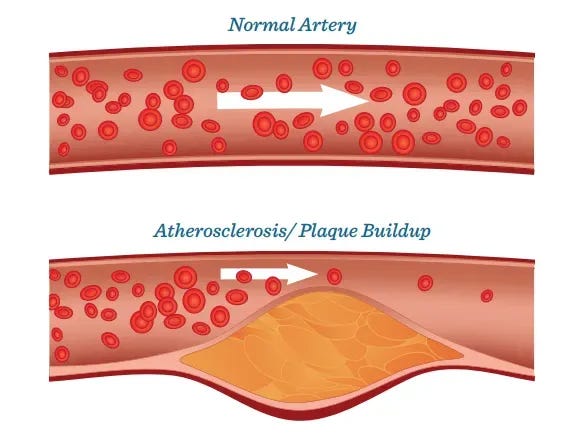
The early victories in cardiovascular disease came from improvements in public health campaigns, early detection, and treatment. Reduction in smoking rates made a large impact, and the beneficial effects were much more immediately felt on blood vessels than on DNA strands in the lung. Blood pressure screening and cardiac imaging made it easier to catch issues early. Defibrillators, advanced heart surgeries, and stents made heart attacks dramatically more survivable. But how do you go from there to preventing heart disease with a pill?
Eyes on the right mechanism

A large study commissioned in 1948 studied 5,209 participants in Framingham, Massachusetts, in order to better understand ‘risk factors’ for cardiovascular health (I write ‘risk factors’ in quotes because the term only existed as a result of the study!). Within a decade, it became apparent that cholesterol and high blood pressure were both related to the development of heart disease. This kicked off a wave of attempts to modulate both, with the first intervention-based drug trial (the Coronary Drug Project) testing estrogen, dextrothyroxine, clofibrate, and nicotinic acid. Estrogen and dextrothyroxine were stopped early due to increasing mortality. Clofibrate did not do much good and had gallstones as a negative side effect. Nicotinic acid did emerge out of the study as a winner, but the effect was so modest it took decades to confirm. Several other high-profile failures led to many doubts about the overall approach, as either the drugs failed or had so many side effects that they were ultimately not worth the tradeoffs.
In the early 1970s, a Japanese researcher by the name of Akira Endo took a new approach. Some fungi are able to block cholesterol synthesis as a defense mechanism; what if you investigated the mechanism behind these natural blockers? It turns out the key is a compound that blocks a key enzyme responsible for cholesterol synthesis.
This was the breakthrough the field needed. The 1994 4S study testing one of these compounds, simvastatin, was able to reduce mortality by over 30% and paved the way towards a drug class that would reduce cardiovascular events for hundreds of millions of people3. It also opened the possibility, realized many years later, of running cardiovascular trials without the necessity of waiting years for heart attacks to occur. Today, trials underway to reduce risk of heart disease have cause for optimism as soon as they demonstrate that LDL-C levels have dropped, a readout measurable through a simple blood draw.
Cancer prevention has been on a similar path

Initially, the story of cancer prevention resembled that of cardiovascular disease risk reduction. Improved diagnostics and public health measures made a meaningful impact on lowering cancer mortality early on. The next step was to launch massive trials to find drugs that could prevent cancer.
But cancer prevention did not have its equivalent of the Framingham Heart Study. Many trials funded by the National Cancer Institute were launched to test dozens of interventions with equally many plausible mechanisms, including finasteride, tamoxifen, beta-carotene, calcium, and selenium. The tamoxifen trial became the most well-known, testing a drug theorized to prevent breast cancer in women who were at increased risk (largely due to age). Tamoxifen is a molecule that modulates the effects of estrogen, a pro-growth signaling molecule used by some cancers, and was quite effective as a treatment specifically for estrogen receptor-positive breast cancer. Follow-up studies showed that long-term tamoxifen treatment led to decreased breast cancer recurrence, creating a compelling case to try using it for cancer prevention.
The trial enrolled 13,000 (!) women in 1992. Five years later, the study was unblinded early because the core readout was a smashing success. Women on the treatment arm had half the incidence of breast cancer as those on placebo. What’s more, the incidence of hip and spine fractures was significantly decreased, due to the effects of estrogen signaling on bone growth. Based on these results, the FDA approved tamoxifen for breast cancer reduction.
Unlike the case of statins, prophylactic tamoxifen use immediately received a great deal of pushback. The key flaw was the finding that tamoxifen - in addition to reducing breast cancer incidence - more than doubled the risk of endometrial cancer. Risks of stroke, pulmonary embolism, and deep-vein thrombosis were increased as well. Increased hot flashes and nausea made the drug unpleasant to take immediately. But the storm had already been brewing long before the tamoxifen trial had its key readout, as the CARET study testing beta-carotene for lung cancer was stopped early a year prior due to finding an increase in lung cancer in the treatment group. Not long thereafter, the tamoxifen finding would also find itself embroiled in a general pharmacological prophylaxis controversy due to the extremely controversial Women’s Health Initiative findings around hormone replacement therapy4.
Around the same time, prostate cancer found an effective preventative agent in finasteride. Though the trial was successful, there was massive concern over the finding that the Gleason score of prostate cancers in patients who were taking finasteride were higher than those on placebo. It would take years to understand the reason - it turns out that finasteride generally shrinks the prostate, making cancers look relatively bigger. This was long after the damage had already been done, and finasteride is much more known today for its ability to prevent male pattern hair loss rather than its potential to decrease cancer risk.
There would be one more big push for cancer prevention, in the form of NSAIDs for the prevention of colorectal cancer. These, too, exploded in a similar way - a generally positive readout on cancer prevention with a concurrent increase in risk of cardiovascular events5.
What are we to make of this?
The many attempts at cancer prevention, including tamoxifen, share a great deal with the history of heart disease risk reduction. Both fields benefited from public health campaigns aimed at lifestyle changes. Advances in early detection, medical devices, and treatment revolutionized each. Yet, nearly forty million Americans take statins while fewer than a million women prophylactically take tamoxifen.
A key difference is in mechanism. The cardiovascular field identified a core molecular cause of atherosclerosis, high blood LDL cholesterol levels, and found drugs to lower it. The path was difficult, and finding a balance of efficacy and safety took a great deal of trial-and-error, but the north star was nevertheless correct. In cancer prevention, interventions hit a wide range of potential mechanisms: signaling (tamoxifen, finasteride), inflammation (NSAIDs), reactive oxygen species (beta-carotene, selenium), and much more. This is not for lack of a core mechanism - genomic instability driving mutational accumulation has long been recognized as a central driver of cancer. Population studies of groups with mutations in DNA repair consistently show elevated cancer risk. The most well-known genes relevant to higher risk of cancer, BRCA1 and BRCA2, encode proteins responsible for DNA repair. Cancer-driving mutations accumulate on our genomes over our lifespans, in much the same way that LDL particles build up on our arteries. And yet, interventions targeting DNA damage are rare6.
A second difference is in readout. LDL cholesterol levels can be measured with a simple blood test. This makes it far easier to identify the people most likely to benefit and confirm that the drugs are working (or, at least, gain conviction that they will). The first intervention-based trials were massive and expensive in scope to ensure that the key causal biomarker was, in fact, causal, but they unfurled the red carpet for much faster followers behind them.
To rapidly accelerate the field, I advocate there is a dire need for two key technologies:
Identification of pharmacological interventions that protect against mutations. This could be in the form of either protecting cells from DNA damage or eliminating those with dangerous errors.
Development of novel tools to measure mutational burden before cancer arises. Each cell, on average, develops approximately 20 mutations per year. If we could measure the slowing of the mutational clock, we could reduce the time it takes to obtain a cancer prevention trial readout by years.
The inflection point in cancer prevention is coming
Both fronts have moved in the last few years. One of the most interesting involves a molecule familiar to anyone who has spent time in the longevity field. Nicotinamide, an NAD metabolite that plays a key role in fixing DNA lesions, significantly decreases the recurrence of non-melanoma skin cancers. The study was especially notable because, unlike the 5+ year long clinical trials typical in the prevention space, the positive readout took no more than a year.
Not every mutation is random. Nearly all cervical cancers are driven by persistent HPV infection, which disables key tumor-suppressor pathways and destabilizes the cellular genome. Australia is on track to become one of the first countries to eliminate cervical cancer by 2035, largely through HPV vaccination and nationwide screening.
Preventing mutations is difficult. What if, instead, you let them accumulate and went after the cells carrying them? Two results arrived this year. In colorectal cancer, cancer vaccines targeted against neoantigens (mutated versions of existing genes) showed a strong immune response. In melanoma, Moderna released results from a cancer vaccine study investigating recurrence that doubled the company’s stock price overnight.
Novel ways to measure cancer risk have begun to bear fruit in recent years. One of the greatest challenges in mutational profiling has been the inability to read individual DNA molecules, complicating efforts to understand how many mutations a person carries. The main challenge is that the technology used to read DNA has a bigger error rate than the number of mutations that DNA generally has, meaning that it’s impossible to distinguish signal from noise. Cleverly, researchers realized there is one special property of DNA that could solve this problem: its double-stranded nature. Each strand of DNA should be the exact complement of the other. If you find a mutation on one strand that isn’t on the other, it’s a sign of a technical artifact. Signal, in turn, is found where both strands have a shared mutation. Maturation of this technology will allow us to track cancer risk in real time.
None of this will be easy. Cholesterol wasn't: it took a massive decades-long observational study to find the main risk driver, another twenty years to find a drug worth taking, and a long list of failures in between. But twenty mutations per cell per year is a number, and numbers can be lowered - once you can measure them.
Acknowledgements: Many, many people were helpful in enlightening me about the history of cancer prevention. They include Professor Sir John Burn, NCI Division of Cancer Prevention Director Philip Castle, NCI Division of Cancer Prevention Associate Director Leslie Ford, Professor Eduardo Vilar-Sanchez, and Professor Christina Curtis. On the cardiovascular side, Alex Kesin and Josef Byrne were instrumental in providing deep knowledge and resources. Any opinions warranting controversy, and mistakes, are mine alone.
Conflict of interest: I founded a company working on cancer prevention.
There’s a terminology war happening in the cancer prevention space currently, with some advocates preferring the term ‘chemoprevention’ or ‘cancer interception’ or ‘cancer prophylaxis.’ Some of this is somewhat pedantic - ‘cancer prevention,’ one could argue, implicitly assumes that someone will get a cancer that is proactively prevented. There is also a desire to have terminology that separates pharmacological interventions from policy actions (such as advocating for smoking cessation). I’m sticking with cancer prevention because it feels the most intuitive.
More accurately - each particle that contributes to plaques is measured by apolipoprotein B (apoB), a carrier. apoB is a superior measure of plaque-forming units, but LDL-C is a more common readout that usually tracks closely with apoB.
The 4S trial was technically focused on determining if a statin could prevent heart disease in individuals who had already had a heart attack (secondary prevention). The West of Scotland Coronary Prevention Study would prove the same for primary prevention a year later.
One major win did emerge in the effort to use NSAIDs for cancer prevention: the use of aspirin for preventing colorectal cancer in patients with Lynch syndrome.
It’s important to point out the core basis for many of the antioxidant trials was preventing DNA damage. Unfortunately, the evidence that antioxidants prevent DNA damage in people at clinically relevant doses is sparse.